Asheville, NC · Garage Door Service
Is Your Older Garage Door Worth Fixing in Asheville
Asheville's housing stock runs 1957-2001, median 1982. Here's how to tell if your door's age and the mountain cold make repair worth it, or not.
- Repairs & new doors
- Springs & openers
- Serving 4 nearby communities
Checking It Yourself
Most of the doors we get called on in this part of Asheville went up somewhere between 1957 and 2001, with the median landing around 1982. That matters because a door from that era is likely original or on its second opener, and the hardware underneath it was built for a different set of expectations than what's sold today.
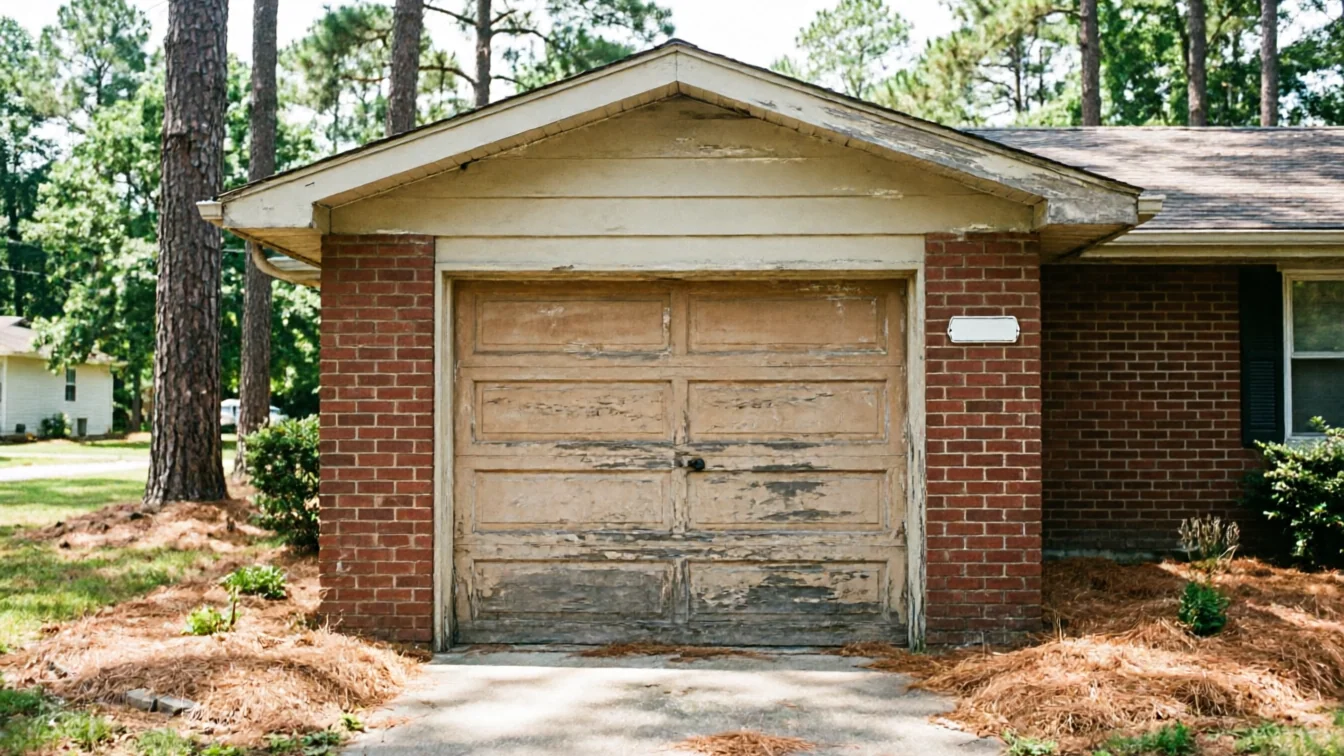
Start by opening the door halfway and letting go. If it drops, the torsion spring has lost tension or snapped - common on a door this age, and not something to force open by hand after that. Look at the track for rust pitting, not just surface orange. Mountain winters push condensation into steel that was never galvanized to today's standard, and on a 1980s door that means the rollers and hinges are often more worn than the panels themselves.
Check the bottom panel for water staining or soft spots. Across the 23 named areas here, most houses share that same build window, so the failure pattern repeats: panels hold up fine, but springs, cables, and the bottom weatherseal wear out on a predictable timeline. If the panels are still straight and the dents are cosmetic, you're usually looking at a hardware fix, not a replacement.
How Local Conditions Play In
Asheville sits in a cold-severe climate band, and that changes what 'worth fixing' means here compared to a milder place. Steel contracts in hard cold, and a door that's already 30 to 40 years old - built when insulation specs were thinner - loses whatever thermal value it had faster than a newer one would. On a garage that backs onto a heated space, that's a real line item on a winter heating bill, not just a comfort complaint.
Cold also stiffens the lubricant in older springs and bearings, so a marginal spring that limps along in October can snap outright in a January cold snap. If your house falls into that 1980s-90s stock that makes up most of this area, the springs were sized for the door's original weight, not for a thicker insulated replacement panel someone may have swapped in later. A mismatched spring under cold load is one of the more common emergency calls we see from houses in this build range.
None of this means replace on sight. A sound door with tired hardware is still a hardware job. But a door that's already uninsulated, cold-stiff, and rusted at the track is fighting the climate on every front, and that's a different conversation than a single broken part.
When to Call Someone
Call before you touch anything if the spring has already let go, or if the door is crooked in the frame - on a torsion system that's not a DIY adjustment, and forcing it risks the cable next. If you're in Oakley, Grove Park-Sunset, Haw Creek, or anywhere else close in, that's a short drive for us; further out toward Black Mountain or Mars Hill it's still doable, just plan for drive time.
Call sooner rather than later if the door is original to a house built in the 1960s or 70s - the older edge of that 1957-2001 range - and you're noticing new noise, new drag, or a wider gap at the bottom seal. Those are early signs the hardware is nearing the end of what it can take, and replacing a spring on a door that's about to need a new bottom panel anyway is money spent twice.
We'll tell you straight if a repair isn't worth it. A door with rotted wood panels, a badly bowed track, or an opener and spring both failing at once usually costs more to patch piece by piece than to replace outright. That's the one honest limit here: we don't stretch a repair just to avoid saying replace.
The Problem
The core issue with older doors in this area isn't neglect, it's mismatch. A door built to 1980s spec, on a house in a cold-severe climate, is being asked to do a job it wasn't designed for by current standards - better insulation, heavier panels, quieter openers - and homeowners often patch one part without touching the rest.
Across the roughly 23,215 owner-occupied houses in this service area, most sitting in that same 1957-2001 build window, we see the same pattern: a spring gets replaced, then two years later the opener strains against a track that's slightly out of plumb, then the weatherseal finally fails and nobody notices until the garage floor's wet in February.
Fixing it piece by piece can be the right call if the door itself is structurally sound - straight panels, intact frame, no major rust-through. It stops being the right call once you're replacing the third major component on a door that was already near the end of its expected service life for this climate. At that point the fix is a new door, not another part.
Frequently asked questions
How old does a garage door have to be before replacement makes more sense than repair?
There's no fixed year, but if your house falls on the older end of the 1957-2001 range here and the door has had two or more major hardware failures - spring, then opener, then track - replacement usually costs less over time than another round of repairs, especially with cold-season stress added in.
Why does my door act up more in winter?
Asheville's cold-severe climate stiffens lubricant and makes steel contract, so a spring or bearing that's already worn is more likely to fail in a cold stretch than in summer. Doors built in the 1980s-90s era common here were sized for the original panel weight, which adds strain if anything's been swapped since.
Is it worth insulating an old door instead of replacing it?
Sometimes, if the panels and frame are still sound. But a door built before modern insulation specs often loses more heat through the frame and seals than the panel itself, so adding foam alone may not fix a drafty garage. We'd look at the whole door before recommending a patch.
Related garage door services in Asheville
More garage door guides
Book garage door service in Asheville
Call now or request a quote - tell us what the door is doing and where you are.